
I now literally have more fiber than I know what to do with.
The exciting acquisitions:
- 4 oz superwash in Leaf from Pigeonroof Studios (Yay! It's always a good day when I can get some of Krista's fiber.)
- 8 oz. soysilk/wool in Alia colorway from marion
- 4 oz. Shetland in Reds colorway from marion
And something I'm especially excited about:
- 8oz CVM roving and 2 oz. English Leicester Longwool from Frontier Fiber Farm (also at sheepythyme).
This fiber is amazing. Bonnie also sent me a bonus 2 oz. of a CVM/kid mohair blend that will be so great for socks.
I haven't recieved these yet, but I'm really excited to see what they're like:
- Posey Toes sock batts in Lunaria and Snake Plant colorways from feistywomandesigns
Tuesday, April 22, 2008

Wednesday, April 16, 2008
Tiny looms!
So far this week:
- 2 oz. naturally-dyed Ramboulliet roving in a raspberry colorway from Tactile Fiber Arts, waiting to be chain-plied.
- 4 bias squares on my 7" Hazel Rose loom, made out of leftover sock yarn made from silk, superwash merino, and mohair batts from Franquemont Fibers. They are destined to become a 4-square bolsa like this one.
As part of my obsession with all things fiberarty and purse-size portable, I very willingly jumped on the Weave-It wave.
I have a a set of 4" and 2" vintage Weave-Its in their original Lucite box, a 7" walnut Hazel Rose loom, and I just bought one of her smaller, finer Multi-Looms. That's what you call hardcore.
My motivation for this is pure instant weaving gratification. I have a lot of random scraps of handspun left over, and I loathe seeing these going to waste. A 2" Weave-It square takes 2 yards of yarn. The other is that I love to spin cotton, but it takes forever to spin enough three-ply to make anything. I can make a six-inch cotton washcloth on my Hazel Rose in an evening of watching the CW.
I've been trying to figure out how to use these little squares in a way that doesn't look too...shall we say...church-basement-craft-circle. I'm thinking some omiyage bag patterns would look pretty cool in Weave-It squares.
- 2 oz. naturally-dyed Ramboulliet roving in a raspberry colorway from Tactile Fiber Arts, waiting to be chain-plied.
- 4 bias squares on my 7" Hazel Rose loom, made out of leftover sock yarn made from silk, superwash merino, and mohair batts from Franquemont Fibers. They are destined to become a 4-square bolsa like this one.
As part of my obsession with all things fiberarty and purse-size portable, I very willingly jumped on the Weave-It wave.
I have a a set of 4" and 2" vintage Weave-Its in their original Lucite box, a 7" walnut Hazel Rose loom, and I just bought one of her smaller, finer Multi-Looms. That's what you call hardcore.
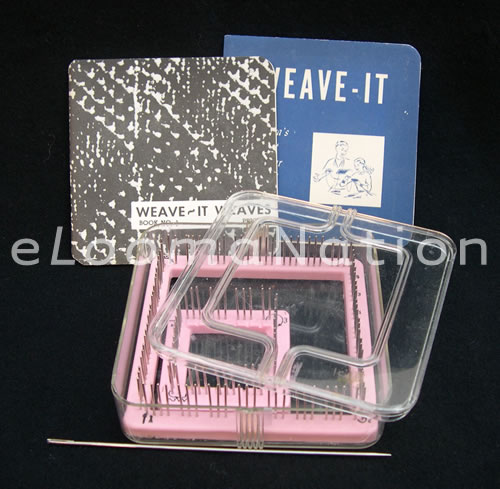
My motivation for this is pure instant weaving gratification. I have a lot of random scraps of handspun left over, and I loathe seeing these going to waste. A 2" Weave-It square takes 2 yards of yarn. The other is that I love to spin cotton, but it takes forever to spin enough three-ply to make anything. I can make a six-inch cotton washcloth on my Hazel Rose in an evening of watching the CW.
I've been trying to figure out how to use these little squares in a way that doesn't look too...shall we say...church-basement-craft-circle. I'm thinking some omiyage bag patterns would look pretty cool in Weave-It squares.
Monday, April 14, 2008
Fruits of the weekend's labors
- 4oz of two-ply worsted baby llama in sea-green handpainted colorway (the January installment of Susan's Spinning Bunny Fondle This club)
- 6 oz. of two-ply worsted alpaca, spun from batts I made from 4 oz. of natural silver Louet baby alpaca and 2 oz. of handpainted alpaca from Lunabudknits in the "Rainbow Suicide" colorway.
- Knitted up 90% of the spindle shawl, and I'm extremely pleased with the results. The only thing that didn't work out so perfectly is that I didn't start the decreases early enough so I've run out of yarn. I wanted this to be made from exactly 2 oz. of fiber, but I'll have to break into my stash a little to finish. Next time, I'll remember that.
It may come as a surprise to some of you that I'm a shutterbug. Last night I got out my (fairly expensive) camera to see if I could take pictures of a lot of my FOs - I'm painfully aware of the picturelessness of this blog and my Ravelry project notebook. However, the light is so bad in my apartment, you guys don't even know. All the photos I took looked like I was taking them for insurance purposes.
I really want one of these: a tabletop lighting kit.
- 6 oz. of two-ply worsted alpaca, spun from batts I made from 4 oz. of natural silver Louet baby alpaca and 2 oz. of handpainted alpaca from Lunabudknits in the "Rainbow Suicide" colorway.
- Knitted up 90% of the spindle shawl, and I'm extremely pleased with the results. The only thing that didn't work out so perfectly is that I didn't start the decreases early enough so I've run out of yarn. I wanted this to be made from exactly 2 oz. of fiber, but I'll have to break into my stash a little to finish. Next time, I'll remember that.
It may come as a surprise to some of you that I'm a shutterbug. Last night I got out my (fairly expensive) camera to see if I could take pictures of a lot of my FOs - I'm painfully aware of the picturelessness of this blog and my Ravelry project notebook. However, the light is so bad in my apartment, you guys don't even know. All the photos I took looked like I was taking them for insurance purposes.
I really want one of these: a tabletop lighting kit.
Thursday, April 10, 2008
Because there isn't enough math in knitting as it is
Wednesday night I went by Ledger's Liquors and with Ed's help, I got my friend Morgan a bottle of Russell's Reserve Rye Whiskey for his birthday and picked up a little something for myself, a bottle of Wathen's Single-Barrel Kentucky Bourbon. Ed Ledger is a man who not only resembles a young Bill Clinton, but is one talented and knowledgable liquor picker. It was probably the influence of these fyne spirits that got me thinking about cellular automation knitting, which as far as I know is the brainchild of Debbie New.
Cellular automation is the mechanism by which a system self-replicates, i.e. every little part of something operates by it's own independent rules, but they all have the same rules, like growing crystals or bacterial colonies.
Way back in the dark ages (I'm talking 1997), there was the Knitlist. It was an email mailing list with something like 1500 people on it, which was substantial even back then. A lot of it is also archived on woolworks, and it was the center of knitting life on the Internet.
I had picked up a copy of Knitter's (remember when that magazine didn't suck?) and because I'm a geek I was fascinated by an article on cellular automation and how the principles could be applied to knitting. Of course, I didn't really get it (it's not a simple concept) so I posted my first and only email to the knitlist asking for help. I got an email from the actual Debbie New, who'd written the article. Over the course of several emails, she'd helped me get the concept down. I printed out all those emails and stuck them in my knitting notebook, knitted a couple of scarves in CA lace, and promptly forgot it. I still have the notes, in my knitting notebook, at the bottom back corner of my storage space. Blast!
But the Internet never forgets, and thanks to the knitting-and site:
"You start with a seed row. Imagine you are working with a dark yarn on a light background. You scatter your dark seeds across the bottom row. As you get to your second row, you look down at the seed row. Each dark seed will be able to touch three stitches in the new row. The color of the stitches in the new row is determined by the location of the seeds. If a new stitch will be touching exactly one seed, either by being directly above or to the upper right or left of the seed, then you knit that stitch with the dark yarn.
Translating this to lace, which is a two stitch (YO, K2TOG) combo, looks a little something like this:
What this means is when deciding how to work a new stitch, I'm looking at the stitch below to the left, directly below, and below to the right. If the stitch directly below is not a YO, but the one below and to the left or below and to the right is, I (YO, K2TOG). If they're both YOs, I knit a regular stitch. If I have to to do a K2TOG where there should be a YO, the K2TOG always takes precedence. The resulting pattern is sort of an organic triangular pattern that reminds me of snakeskin.
I love this, because the results are unpredictable and the rule is easy to remember. Total surprise lace. I'm going to knit my next spindle shawl in this and see how it turns out.
Cellular automation is the mechanism by which a system self-replicates, i.e. every little part of something operates by it's own independent rules, but they all have the same rules, like growing crystals or bacterial colonies.
Way back in the dark ages (I'm talking 1997), there was the Knitlist. It was an email mailing list with something like 1500 people on it, which was substantial even back then. A lot of it is also archived on woolworks, and it was the center of knitting life on the Internet.
I had picked up a copy of Knitter's (remember when that magazine didn't suck?) and because I'm a geek I was fascinated by an article on cellular automation and how the principles could be applied to knitting. Of course, I didn't really get it (it's not a simple concept) so I posted my first and only email to the knitlist asking for help. I got an email from the actual Debbie New, who'd written the article. Over the course of several emails, she'd helped me get the concept down. I printed out all those emails and stuck them in my knitting notebook, knitted a couple of scarves in CA lace, and promptly forgot it. I still have the notes, in my knitting notebook, at the bottom back corner of my storage space. Blast!
But the Internet never forgets, and thanks to the knitting-and site:
"You start with a seed row. Imagine you are working with a dark yarn on a light background. You scatter your dark seeds across the bottom row. As you get to your second row, you look down at the seed row. Each dark seed will be able to touch three stitches in the new row. The color of the stitches in the new row is determined by the location of the seeds. If a new stitch will be touching exactly one seed, either by being directly above or to the upper right or left of the seed, then you knit that stitch with the dark yarn.
..."new row xxx x x
seed x xx
Translating this to lace, which is a two stitch (YO, K2TOG) combo, looks a little something like this:
Row5   O/O/    O/O/ O/  O/  O/

Row4    O/      O/ O/    O/O/

Row3     O/O/O/O/ O/      O/

Row2      O/  O/   O/O/O/O/

Row1       O/O/     O/  O/

seed        O/       O/O/
What this means is when deciding how to work a new stitch, I'm looking at the stitch below to the left, directly below, and below to the right. If the stitch directly below is not a YO, but the one below and to the left or below and to the right is, I (YO, K2TOG). If they're both YOs, I knit a regular stitch. If I have to to do a K2TOG where there should be a YO, the K2TOG always takes precedence. The resulting pattern is sort of an organic triangular pattern that reminds me of snakeskin.
I love this, because the results are unpredictable and the rule is easy to remember. Total surprise lace. I'm going to knit my next spindle shawl in this and see how it turns out.
Feed the addiction
Tuesday, Kristine finally set out the fiber she's selling so we can all see it. I know she wants to be appropriate and all and not mix business with social events and that shows how well-bred she is. However, I'd tease her about how I feel weird about sneaking back in her fiber room to check out the merchandise. Even though I know that's what she wants me to do, I feel like I'm going through her medicine chest or underwear drawer or something.
So this time she set out a shelf and some baskets of yarn and fiber and I felt relieved - especially when I feasted my eyes on her polwarth roving in the "El Rio" colorway. At first I was thinking, well, I have a lot of fiber on deck, I'll just hang back and not get some. But Mike started picking out fiber to buy like a perfectly reasonable person and the addict part of my brain went all paranoid and started shrieking "MINE MINE!" like a kindergartner. I ended up with 8 oz. of the stuff because I'm not a reasonable person. I don't regret it. :)
I will be so sad when her naturally-dyed polwarth is gone (most of it already is it seems). But there's always next year, and her other pretty fiber to keep me occupied until then.
Speaking of utterly remorseless impulse buying, I went and ordered the Morehouse Merino Monet Shawl KnitKit the other day. I can't help it - I'm fixated on Impressionism after Eric took me to the Barnes Foundation in Philadelphia and I want a Waterlilies shawl, goddamit! I also bought three new shorty Grafton spindles - a Mala, a mini Swan, and another Fibership, all in pretty wood laminates - mostly for portable spinning. They have the shorter shafts which make them easier to stick in a little project bag.
I actually broke a spindle a few weeks ago, my Dave Larsen acrylic laser etched one, and I'm totally in mourning, which is why I bought the Graftons. They've grown on me for sure. I really think that for all-around value for money in terms of artisan spindles Bosworths are the way to go (they're absolutely no-fail - you can spin anything on just about any of them). The advantage the Graftons have is they are not only fairly well-designed (especially the Swans) but are built Tonka-tough. I worry a lot less about breaking them in my travel bag, whereas I'd worry about my Bosworths.
(Oh my god, if I broke one of my Bosworths I'd be inconsolable.)
So this time she set out a shelf and some baskets of yarn and fiber and I felt relieved - especially when I feasted my eyes on her polwarth roving in the "El Rio" colorway. At first I was thinking, well, I have a lot of fiber on deck, I'll just hang back and not get some. But Mike started picking out fiber to buy like a perfectly reasonable person and the addict part of my brain went all paranoid and started shrieking "MINE MINE!" like a kindergartner. I ended up with 8 oz. of the stuff because I'm not a reasonable person. I don't regret it. :)
I will be so sad when her naturally-dyed polwarth is gone (most of it already is it seems). But there's always next year, and her other pretty fiber to keep me occupied until then.
Speaking of utterly remorseless impulse buying, I went and ordered the Morehouse Merino Monet Shawl KnitKit the other day. I can't help it - I'm fixated on Impressionism after Eric took me to the Barnes Foundation in Philadelphia and I want a Waterlilies shawl, goddamit! I also bought three new shorty Grafton spindles - a Mala, a mini Swan, and another Fibership, all in pretty wood laminates - mostly for portable spinning. They have the shorter shafts which make them easier to stick in a little project bag.


I actually broke a spindle a few weeks ago, my Dave Larsen acrylic laser etched one, and I'm totally in mourning, which is why I bought the Graftons. They've grown on me for sure. I really think that for all-around value for money in terms of artisan spindles Bosworths are the way to go (they're absolutely no-fail - you can spin anything on just about any of them). The advantage the Graftons have is they are not only fairly well-designed (especially the Swans) but are built Tonka-tough. I worry a lot less about breaking them in my travel bag, whereas I'd worry about my Bosworths.

(Oh my god, if I broke one of my Bosworths I'd be inconsolable.)
Wednesday, April 09, 2008
Being the bigger person
Part of the reason I took up this blog again is that I'm intensely passionate about fiberarts and as a result I have some strong, probably unpopular opinions that are best kept off the Ravelry forums and the Handspinning community. I also use this as an idea notebook and I'm thrilled that people actually read it sometimes (HI PEOPLE READING!).
I say this because Kristine bought me the latest issue of Spin-Off, and I stayed up way past my bedtime last night reading it. I've never had a lot of good things to say about the magazine in the past. Some of my criticisms have been:
- The articles are oriented to absolute beginners
- The articles are oriented to arcane techniques
- The patterns/techniques are ugly (come on, you have to admit, there has been some fug)
- The articles on individual spinners are too "in-flight magazine"
However, I want to go on record and say I might be wrong about Spin-Off. I found tons of really great information in this month's issue. It's possible the magazine evolved a little since I read it last, but most likely it's that I matured a lot as a spinner.
Next quarter, I'm probably going to do a trial subscription. That's right, you heard me - TRIAL SUBSCRIPTION!
Last night I was over at at Kristine and Adrienne's and Sara, Marlowe, Krista, and a new fun person, Mike of the Yknit podcast was there. As usual, it was a scream, and as usual I stayed way, way too late. It was really great to have Mike there, a rooster in the henhouse so to speak, and I hope to see him again at some future fiber events.
I really need to start a blogroll.
I say this because Kristine bought me the latest issue of Spin-Off, and I stayed up way past my bedtime last night reading it. I've never had a lot of good things to say about the magazine in the past. Some of my criticisms have been:
- The articles are oriented to absolute beginners
- The articles are oriented to arcane techniques
- The patterns/techniques are ugly (come on, you have to admit, there has been some fug)
- The articles on individual spinners are too "in-flight magazine"
However, I want to go on record and say I might be wrong about Spin-Off. I found tons of really great information in this month's issue. It's possible the magazine evolved a little since I read it last, but most likely it's that I matured a lot as a spinner.
Next quarter, I'm probably going to do a trial subscription. That's right, you heard me - TRIAL SUBSCRIPTION!
Last night I was over at at Kristine and Adrienne's and Sara, Marlowe, Krista, and a new fun person, Mike of the Yknit podcast was there. As usual, it was a scream, and as usual I stayed way, way too late. It was really great to have Mike there, a rooster in the henhouse so to speak, and I hope to see him again at some future fiber events.
I really need to start a blogroll.
Tuesday, April 08, 2008
Artfibers Hana
I was going away for the weekend last week and I needed an emergency project for the plane, so I ran over to Artfibers and bought about 100g of Hana, which is a very nice 2-ply silk sportweight. I'm knitting some kind of smoke ring out of it, made up of garter stitch and dropped loop stitches.
I also picked up some of their spinning fiber, called Miso, which is a merino/soysilk blend. Generally speaking, their yarns aren't my thing - lots of ribbon and stuff, but it is pretty. I would like to see more spinning fiber along the lines of their design philosophy, though.
I also picked up some of their spinning fiber, called Miso, which is a merino/soysilk blend. Generally speaking, their yarns aren't my thing - lots of ribbon and stuff, but it is pretty. I would like to see more spinning fiber along the lines of their design philosophy, though.
Friday, April 04, 2008
In which I prove my mastery of junior high geometry
I was contemplating the Elizabeth Zimmerman Pi Shawl, of which I've knit about a million, and I always forget the basic formula. So the thing I do know thanks to six years of university-level math is the formula for the circumference of a circle, which is:
C = Π2r
Where r = the radius, which is the distance from the center to the edge of a circle.
Now, when knitting a circular bit of knitting, each row increases the area of the circle in all directions, threfore, the radius isn't as applicable as the diameter, which is the distance from one edge of of the circle to the edge directly on its opposite.
The diameter of a circle is:
d=2r
So the circumference of a circle can be expressed as:
C=Πd
Thanks to the beautiful mathematical mystery that is the Algebraic Distributive Property, the every time the diameter of a circle doubles, so does the circumference! Check it out:
2(C) = 2(Π) x 2(d)
So what does this mean for my knitting? It means that to knit a perfect circle, you need to increase to twice the number of stitches every time you double the number of rows since your last increase round. For example:
Cast on 8 stitches in the round.
Knit three rounds.
K1, yo to end of round, 16 stitches.
Knit six rounds.
K1, yo to end of round, 32 stitches.
Knit twelve rounds.
K1, yo to end of round, 64 stitches.
...and so on, and so on, until you run out of yarn or your hands fall off, whichever comes first.
C = Π2r
Where r = the radius, which is the distance from the center to the edge of a circle.
Now, when knitting a circular bit of knitting, each row increases the area of the circle in all directions, threfore, the radius isn't as applicable as the diameter, which is the distance from one edge of of the circle to the edge directly on its opposite.
The diameter of a circle is:
d=2r
So the circumference of a circle can be expressed as:
C=Πd
Thanks to the beautiful mathematical mystery that is the Algebraic Distributive Property, the every time the diameter of a circle doubles, so does the circumference! Check it out:
2(C) = 2(Π) x 2(d)
So what does this mean for my knitting? It means that to knit a perfect circle, you need to increase to twice the number of stitches every time you double the number of rows since your last increase round. For example:
Cast on 8 stitches in the round.
Knit three rounds.
K1, yo to end of round, 16 stitches.
Knit six rounds.
K1, yo to end of round, 32 stitches.
Knit twelve rounds.
K1, yo to end of round, 64 stitches.
...and so on, and so on, until you run out of yarn or your hands fall off, whichever comes first.
Thursday, April 03, 2008
Writing this down before I forget
Technique to counter biasing when knitting with energized singles:
Knit with two balls/colors, one on each end of the work. The twist will balance it out!
Score!
Knit with two balls/colors, one on each end of the work. The twist will balance it out!
Score!
I'm weak
Yesterday saw the purchase of two KnitKits from Morehouse Merino: the ChocolateMint Scarf and the Waves Shawl. You have to admit, they're fabulous.
Also, I transcended the boundaries of distance and language to buy a couple of shawl patterns from Dorthea Fischer, the lady who (along with some friends) wrote the Danish tie-shawl article in this month's Spin-Off (a copy of which the divine Ms Kristine picked up for me).
You absolutely have to love these shawls. I mean, just look at them.
Especially this one. I have a fantasy of tying on my shawl, putting on my hat and mitts and going out in the cold morning to feed the spinner's flock. This is why my sisters call me The Goat Lady.
I have a fascination with "working shawls". Due to my tendency to travel long distances in very short periods of time, I've developed a "nomad" mentality, where if I'm going to be carrying something around, I want it to be as portable, useful, and yes, pretty as possible. Shawls can be cover-ups, mufflers, blankets, pillows, coat substitutes, and in a pinch, picnic blankets and bedrolls. Therefore, give me something I can wear as a jacket and sleep under when I'm stranded in Chicago Midway airport.
Also, I transcended the boundaries of distance and language to buy a couple of shawl patterns from Dorthea Fischer, the lady who (along with some friends) wrote the Danish tie-shawl article in this month's Spin-Off (a copy of which the divine Ms Kristine picked up for me).
You absolutely have to love these shawls. I mean, just look at them.
Especially this one. I have a fantasy of tying on my shawl, putting on my hat and mitts and going out in the cold morning to feed the spinner's flock. This is why my sisters call me The Goat Lady.

I have a fascination with "working shawls". Due to my tendency to travel long distances in very short periods of time, I've developed a "nomad" mentality, where if I'm going to be carrying something around, I want it to be as portable, useful, and yes, pretty as possible. Shawls can be cover-ups, mufflers, blankets, pillows, coat substitutes, and in a pinch, picnic blankets and bedrolls. Therefore, give me something I can wear as a jacket and sleep under when I'm stranded in Chicago Midway airport.
Wednesday, April 02, 2008
Internet community drama
Apparently, the woman who owned the LiveJournal communities "spinningfiber", "dyeingfiber", "sellingfiber", and "weavingfiber" deleted them all yesterday afternoon for reasons that are not entirely clear but most likely have to do with her personal issues. The real tragedy of this is the collective wisdom of the 1500 spinners who were active there, many of whom are a pretty big deal in the spinning realm, has gone up in a puff of bytes.
However, in happier news, I finally got another 3.5 ounces of the "Rose Garden" wool, silk, and angora batt I bought from Crystal Creek Fibers spun and plied up and the top-down v-neckish, shawl-collar-y cardigan I'm making with it is back in process, just in time for summer when it will be way to warm to wear. One of the mysteries of the Schacht Matchless - the bobbins hold way more when they're full of singles than they do when they're full of plied yarn, which means I generally have about half an ounce of orphan single left on my bobbin. That is annoying, but I'm not counting out user error.
I think I have also figured out how to maybe get away with knitting at work. Needless to say, public knitting at my office would be frowned upon - not because they have any issues with knitting per se, but it would raise the question as to why I have so much spare time to knit. That's a conversation I'd never want to get into. So I've taken a very small project (the spindle shawl) and put it into a brightly-colored cosmetic pouch. When I need a knitting break, I just leave my desk and walk in the direction of the bathroom with this pouch, and nobody asks any questions. Then, I go out to the staircase and knit a few rows.
However, in happier news, I finally got another 3.5 ounces of the "Rose Garden" wool, silk, and angora batt I bought from Crystal Creek Fibers spun and plied up and the top-down v-neckish, shawl-collar-y cardigan I'm making with it is back in process, just in time for summer when it will be way to warm to wear. One of the mysteries of the Schacht Matchless - the bobbins hold way more when they're full of singles than they do when they're full of plied yarn, which means I generally have about half an ounce of orphan single left on my bobbin. That is annoying, but I'm not counting out user error.

I think I have also figured out how to maybe get away with knitting at work. Needless to say, public knitting at my office would be frowned upon - not because they have any issues with knitting per se, but it would raise the question as to why I have so much spare time to knit. That's a conversation I'd never want to get into. So I've taken a very small project (the spindle shawl) and put it into a brightly-colored cosmetic pouch. When I need a knitting break, I just leave my desk and walk in the direction of the bathroom with this pouch, and nobody asks any questions. Then, I go out to the staircase and knit a few rows.
Tuesday, April 01, 2008
Lord help me I love this
The Morehouse Merino ChocolateMint Shawl KnitKit.
I know it's just a garter stitch bias square in two colors of yarn; it really couldn't be simpler to reverse-engineer.
But it's so pretty. I need to keep some perspective on this.
P.S. I forgot to mention I bought the Monet Scarves KnitKit in Blue Nympheas last week It seemed like a decent deal.
I know it's just a garter stitch bias square in two colors of yarn; it really couldn't be simpler to reverse-engineer.
But it's so pretty. I need to keep some perspective on this.
P.S. I forgot to mention I bought the Monet Scarves KnitKit in Blue Nympheas last week It seemed like a decent deal.
Monday, March 31, 2008
Because I wanna
I was having one of my punk rock tantrums this weekend. You know, like the Hives song:
"Do what I want cause I can and if I don't because I wanna!"
("Hate to say I told you so...ALRIGHT!")
So I stuck my wallet, keys, pepper spray (can never be too careful), and Blackberry in my pocket, grabbed my latest small project (in a Daiso bento bag, no less) and headed for the woods.
Saturday, I got deep under the influence of one of Katie's cappucinos and Rachel's Blue Chair jam at Pizzaiolo, so I jittered my way into Article Pract to work it off. While I was there, I picked up the Carmen pattern Kristine made, a pair of metal size 3 sock needles for travel, a 40" size 10.5 Crystal Palace Daisy needle, and 2 2oz. bundles of Kristine's BFL in her "Reyes" colorway. I decided to try that project I mentioned in the previous post, inspired by the Morehouse Merino scarf and shawl patterns.
So, my little Bento bag held the BFL roving, the little rosewood faux-Turkish spindle I got at Stitches West, and my new Daisy needles. Once I spun up a spindleful, I popped off the whorl-arms from the spindle shaft (which makes an excellent thread bobbin!), and cast on three stitches. In garter stitch, I slipped the selvedge stitch and did a yo at the beginning of every row, until I felt it was long enough, then I did a slip selvedge, yo, k2tog, psso at the beginning of the next row, k to end. The next row I did a slip selvedge, yo, k to end as usual for what will be a stole knit on the bias.
When I knit up the entire spindleful, I spin a new spindleful, and do a join between the end of the working yarn and the beginning of the yarn on the spindle. It seems to be working very well.
My only difficulty is with the Daisy needle. It's a nice, smooth plastic needle, but the cable is incredibly stiff and in a rigid coil, like wire. I have to wrestle with it every time I get to the end of a row. I'm hoping I can soften it a little in hot water or something.
"Do what I want cause I can and if I don't because I wanna!"
("Hate to say I told you so...ALRIGHT!")
So I stuck my wallet, keys, pepper spray (can never be too careful), and Blackberry in my pocket, grabbed my latest small project (in a Daiso bento bag, no less) and headed for the woods.
Saturday, I got deep under the influence of one of Katie's cappucinos and Rachel's Blue Chair jam at Pizzaiolo, so I jittered my way into Article Pract to work it off. While I was there, I picked up the Carmen pattern Kristine made, a pair of metal size 3 sock needles for travel, a 40" size 10.5 Crystal Palace Daisy needle, and 2 2oz. bundles of Kristine's BFL in her "Reyes" colorway. I decided to try that project I mentioned in the previous post, inspired by the Morehouse Merino scarf and shawl patterns.
So, my little Bento bag held the BFL roving, the little rosewood faux-Turkish spindle I got at Stitches West, and my new Daisy needles. Once I spun up a spindleful, I popped off the whorl-arms from the spindle shaft (which makes an excellent thread bobbin!), and cast on three stitches. In garter stitch, I slipped the selvedge stitch and did a yo at the beginning of every row, until I felt it was long enough, then I did a slip selvedge, yo, k2tog, psso at the beginning of the next row, k to end. The next row I did a slip selvedge, yo, k to end as usual for what will be a stole knit on the bias.
When I knit up the entire spindleful, I spin a new spindleful, and do a join between the end of the working yarn and the beginning of the yarn on the spindle. It seems to be working very well.
My only difficulty is with the Daisy needle. It's a nice, smooth plastic needle, but the cable is incredibly stiff and in a rigid coil, like wire. I have to wrestle with it every time I get to the end of a row. I'm hoping I can soften it a little in hot water or something.
Thursday, March 27, 2008
Morehouse Merino
I absolutely love Morehouse Merino lace designs. Their shawls and scarves are minimalistic, textural, modern, and innovative - everything I love in knitwear design.
However, I really don't like their yarns. They do have their great points: the variegated colorways are beautiful and they do their best to keep the wool in its natural state (read: they don't carbonize out the VM). What I don't like about them is the randomly-occurring coarseness of the wool (I don't know why - their dye process, maybe?) and their lace yarn is not plied.
The last part is what I have a real problem with. I have been indoctrinated to believe that singles are unsuitable for lace knitting, because of their natural energized state. It makes the lace crumple up so you have to block it over and over. Supposedly, the most suitable yarn for lace knitting is a worsted-spun two-ply.
I'm as iconoclastic as the next person so I'm perfectly willing to knit lace with singles to test that rule, and Morehouse designs seem to be designed to sort of be crushy and crumply, which I like. What is difficult if not impossible to work around is the fragility of singles, especially Morehouse Merino singles. Many of the designs are also heavily dependent on wide multi-stitch-width dropped sections, which leaves the poor yarn exposed to the elements. If during the course of wear there's a break in the yarn, it could affect the entire structural integrity of the piece.
But I'm just speculating. I'm thinking of buying a kit just to see how it goes. If these designs are actually structured in a way that the singles are more-or-less protected, they might be really great spindle projects: spin a spindle full, knit the single until I run out of yarn, spin up another spindle full, splicing the end of the new spindle to the end of the knitting. No ends to weave in!
That's incredibly exciting for someone like me: I loathe finishing. I want my projects to spring fully-formed from my needles like Athena from the forehead of Zeus, and I will go to extreme lengths to achieve that.
Wednesday, March 26, 2008
Another impulse buy
I've really had to curb my fiber impulse buying because I'm seeing a "top of his field" therapist not covered by my health insurance. He's worth it, I assure you, but I spend almost as much on his sessions as I do on rent and as such my slush fund has long since depleted.
Since I can't seem to actually stop buying fiber (which I should probably bring up with my therapist at some point), I've limited it to:
- naturally-dyed fiber, commercially-prepared or not (i.e. things from Kristine or Maia and Brooke)
- Extremely artfully-dyed fiber (i.e. Krista's Pigeonroof stuff)
- non-commercially prepared fiber
So, falling into the last category is the stuff I bought just a few minutes ago, from Spiderweb Specialties' etsy shop. I just couldn't pass these blends up: shetland, alpaca, and angora in natural grey, and shetland, alpaca, and angora in Moorit color. I honestly don't know when I'm going to get around to spinning all this stuff.
I would love to do a fiber swap with some people at some point, as I have lots of really wonderful stuff that I'm either tired of or bought way too much of. Just don't ask me to organize this at the moment.
Since I can't seem to actually stop buying fiber (which I should probably bring up with my therapist at some point), I've limited it to:
- naturally-dyed fiber, commercially-prepared or not (i.e. things from Kristine or Maia and Brooke)
- Extremely artfully-dyed fiber (i.e. Krista's Pigeonroof stuff)
- non-commercially prepared fiber
So, falling into the last category is the stuff I bought just a few minutes ago, from Spiderweb Specialties' etsy shop. I just couldn't pass these blends up: shetland, alpaca, and angora in natural grey, and shetland, alpaca, and angora in Moorit color. I honestly don't know when I'm going to get around to spinning all this stuff.
I would love to do a fiber swap with some people at some point, as I have lots of really wonderful stuff that I'm either tired of or bought way too much of. Just don't ask me to organize this at the moment.
Bison down
I'm trying to decide if it's worth it to buy some.
"Exotics for the sake of exotics" is a good enough reason, really, to buy and spin up as much as you can afford to. However, I'm beginning to feel that certain things are frankly close enough.
For example, for most of my purposes, the luxury feel of alpaca/llama and yak are just awesome. Cashmere and quivut and all those things are fantastic but are outrageously expensive. For the money I end up spending on them, the results are not far and above what I can get with similar but less scarce fiber. Well, except for cashmere. But it's way too warm to wear pure cashmere here anyway so I rarely even end up using a lot of it - not to mention the pilling problem that short fibers have.
Anyhow, Kendig Cottage has Bison for not cheap. I'm wondering if it's really the much more wonderful than yak.
"Exotics for the sake of exotics" is a good enough reason, really, to buy and spin up as much as you can afford to. However, I'm beginning to feel that certain things are frankly close enough.
For example, for most of my purposes, the luxury feel of alpaca/llama and yak are just awesome. Cashmere and quivut and all those things are fantastic but are outrageously expensive. For the money I end up spending on them, the results are not far and above what I can get with similar but less scarce fiber. Well, except for cashmere. But it's way too warm to wear pure cashmere here anyway so I rarely even end up using a lot of it - not to mention the pilling problem that short fibers have.
Anyhow, Kendig Cottage has Bison for not cheap. I'm wondering if it's really the much more wonderful than yak.
Tuesday, March 25, 2008
More Acquisitions
So, last Saturday Sara took me on my first trip to Daiso, because I'm always lusting after her cutie-patootie bento boxes. I bought some really useful things, not the least of which are tons of cute little fabric bento box bags, which are the perfect size for sock projects! And they were only about $3.00 each. I did pick one up which turned out to be insulated, so I'm going to use that for my actual lunch bag.
I decided I wasn't up to going to my finishing class at Knit-One-One (I know, bad me. Knit-One-One is a really excellent place to take classes, though), and we went over to Article Pract, where I got a reality check on how I remember things vis-a-vis What Knitters Are Paying For These Days. In some ways it was good news, other ways bad, but it reaffirmed my choice to become a spinner.
I noticed they were carrying some of Kristine's fiber, way up high on pegs over the till. Not really a high-visibility place for them, but this fiber thing is new for a lot of people so I'm not judging. Not only did I get a chance to shill for Kristine ("Look! This is polwarth, it's really hard to get!"), but I got six ounces of her Blackberry colorway polwarth. Yay! I'm hoping to turn this into at least 800 years, um, I mean yards of laceweight for a smaller version of g.bella's Catalina shawl.
After that, we swung by Kristine and Adrienne's to drop off some things Sara had for them, and saw pictures of the new A Verb for Keeping Warm studio! Wow, totally exciting. It was a superfun day (and Kristine had another bundle of polwarth hiding in her inventory so I made an even 8 oz. score.)
Sunday was Easter mass with my neighbors (I accidentally took them to the Spanish mass at St. Joseph the Worker - turns out our German pastor is also fluent in Spanish), Easter lamb for dinner, and way too much wine. I got the bright idea to spin up the 4 oz. of black BFL I've had in my stash since the winter before last, but I was a little too lit and my single kept coming out uneven. I wanted to ply it with the 50/50 merino-yak I bought a couple of months ago from Maia and Brooke as a present for bugheart when I see her on Friday, but my Easter Monday hangover kept me from getting much spinning done. I have some other pretty, interesting stuff already spun up so I suppose I can give her something else should I need to.
I decided I wasn't up to going to my finishing class at Knit-One-One (I know, bad me. Knit-One-One is a really excellent place to take classes, though), and we went over to Article Pract, where I got a reality check on how I remember things vis-a-vis What Knitters Are Paying For These Days. In some ways it was good news, other ways bad, but it reaffirmed my choice to become a spinner.
I noticed they were carrying some of Kristine's fiber, way up high on pegs over the till. Not really a high-visibility place for them, but this fiber thing is new for a lot of people so I'm not judging. Not only did I get a chance to shill for Kristine ("Look! This is polwarth, it's really hard to get!"), but I got six ounces of her Blackberry colorway polwarth. Yay! I'm hoping to turn this into at least 800 years, um, I mean yards of laceweight for a smaller version of g.bella's Catalina shawl.
After that, we swung by Kristine and Adrienne's to drop off some things Sara had for them, and saw pictures of the new A Verb for Keeping Warm studio! Wow, totally exciting. It was a superfun day (and Kristine had another bundle of polwarth hiding in her inventory so I made an even 8 oz. score.)
Sunday was Easter mass with my neighbors (I accidentally took them to the Spanish mass at St. Joseph the Worker - turns out our German pastor is also fluent in Spanish), Easter lamb for dinner, and way too much wine. I got the bright idea to spin up the 4 oz. of black BFL I've had in my stash since the winter before last, but I was a little too lit and my single kept coming out uneven. I wanted to ply it with the 50/50 merino-yak I bought a couple of months ago from Maia and Brooke as a present for bugheart when I see her on Friday, but my Easter Monday hangover kept me from getting much spinning done. I have some other pretty, interesting stuff already spun up so I suppose I can give her something else should I need to.
Monday, March 17, 2008
First successful batt
I used my birthday present to myself, Strauch Petite drum carder bought from Morgaine at Carolina Homespun, to card up some naturally-dyed polwarth locks from Kristine at A Verb for Keeping Warm in golds, oranges, and pinks.
While the teasing process was a little tedius, the resulting batts were well worth the effort. All the colors blended naturally into a tequila-sunrise sort of blend, with the fibers blending into a fluffy, airy batt. I'll probably card this again with some of Kristine's naturally-dyed yak for a larger volume with more warming properties.
While the teasing process was a little tedius, the resulting batts were well worth the effort. All the colors blended naturally into a tequila-sunrise sort of blend, with the fibers blending into a fluffy, airy batt. I'll probably card this again with some of Kristine's naturally-dyed yak for a larger volume with more warming properties.
Calm a llama down
I bought 4 oz. of chocolate brown llama from Clickety Sticks at Stitches West, and I loved spinning it up. It was a small batch processed roving, lots of air, a little VM but still a pleasure to spin up.
Except, last night I was chain-plying it into a three-ply, and it practically cut my fingers to ribbons.
I wanted to give this as a gift to bugheart when she and grub come to visit at the end of the month, but I'm not so sure it will be her thing. I'm also not so sure I want to finish plying this stuff.
As fora recommended project, it is soft enough for against the skin, but the bits of hay in it might be problematic for that in the long run. Might make a really good cafetiere cozy.
Except, last night I was chain-plying it into a three-ply, and it practically cut my fingers to ribbons.
I wanted to give this as a gift to bugheart when she and grub come to visit at the end of the month, but I'm not so sure it will be her thing. I'm also not so sure I want to finish plying this stuff.
As fora recommended project, it is soft enough for against the skin, but the bits of hay in it might be problematic for that in the long run. Might make a really good cafetiere cozy.
Friday, August 18, 2006
Yarn Hardware
Last night at Deep Color we worked on adding inclusions to our spinning, specifically hardware and charms. I really got into it and am planning on trying all sorts or small found objects.

This is a sample of 2-ply acid-dyed colonial with handmade, hand-tied copper jump rings. The idea is to put little charms or beads or what have you on the jump rings, but I sort of like just the rings. The advantage of the rings is that they can go through the orifice of my spinning wheel.
 '
'
This is a sample of 2-ply acid-dyed orange colonial and purple merino/Tencel blend with hand-tied nickel washers and hex nuts. This one had to be done on a drop spindle because of the size of the washers, which was fun. It's very heavy, so the washers will probably have to be spaced fairly far apart in the future.
I'm planning on trying this technique with everything I can get my hands on, hardware-wise. I think this is a great technique for bags and all that roving that's too coarse for garments.
This is a sample of 2-ply acid-dyed colonial with handmade, hand-tied copper jump rings. The idea is to put little charms or beads or what have you on the jump rings, but I sort of like just the rings. The advantage of the rings is that they can go through the orifice of my spinning wheel.
'This is a sample of 2-ply acid-dyed orange colonial and purple merino/Tencel blend with hand-tied nickel washers and hex nuts. This one had to be done on a drop spindle because of the size of the washers, which was fun. It's very heavy, so the washers will probably have to be spaced fairly far apart in the future.
I'm planning on trying this technique with everything I can get my hands on, hardware-wise. I think this is a great technique for bags and all that roving that's too coarse for garments.
Subscribe to:
Posts (Atom)